Sunday, 29 April 2012

Angels

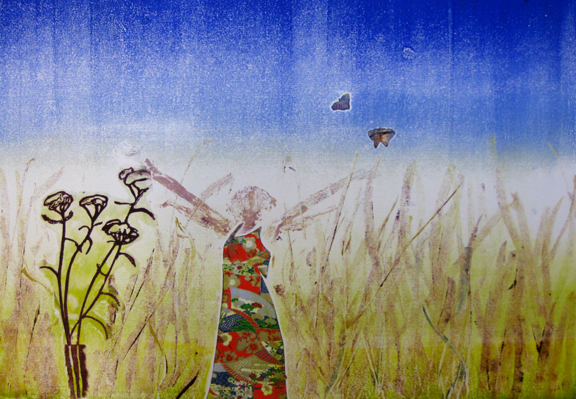
Another Gum Arabic print - I've removed some of the tree from the background for this one in order to show the angel more clearly.  I like the ethereal, slightly disintigrating quality of the image.  

These are very temperamental to print - so I feel particularly pleased when one works!

I had planned to print a few more in the studio today but had a late start.   I went to see a very good cabaret yesterday evening put together by Emma Purshouse at the Bilston Imperial Banqueting Suite.  I enjoyed all the acts but  the Raymond and Mr Timkins Revue were particularly good, as was the compere Steve Rooney.   http://www.raymondandmrtimpkins.co.uk/hello.html

Thursday, 26 April 2012

Any one for tennis?

The gum arabic print was made using an old photograph which my father had taken in his youth in the RAF - in Egypt, I think.

The gum arabic process involves making a black and white photocopy of a (high contrast) photograph or a sketch and using this photocopy as your print 'plate'.    Then:
  1.  sponge gum arabic on the front and the back (it smells like the old gum spreaders that children used to use) and place it on perspex or glass
  2.  roll oil-based etching ink over the suface of the photocopy (add plate oil or linseed oil to it to make it loose, if necessary
  3.  sponge off the ink from the photocopy with a mixture of 50% water and 50% gum arabic - this removes excess ink from the image and takes it away from the pale areas.  (oil based ink sticks to the black toner)
  4. carry out step 2 and 3 again
  5.  then print the image in an etching press, using damp paper. 

I've found that it's good to photocopy your image onto thick paper or even card, if possible.  This makes it easier to handle and less likely to tear.   If you can only get your photocopies on thin paper, then you can strengthen the back of the copy by painting acrylic gel medium on the back.  This really helps the paper survive quite a lot of sponging and wetting!

Gum Arabic prints


I was working with Lin C in her studio in Ludlow last week, experimenting with gum arabic prints last week.  Had a great day.  I'd had a brief experiment with this process a couple of months ago but it didn't really work. Using a different 'recipe' from Anne Philmore, I got a good result.  Thanks Anne! 

This  image is created from a photograph which I took in a local graveyard.  I like the way that the process emphasises the crumbling, fragile nature of the stone itself and, I suppose, the insubstantial nature of angels!  I'm going to try a few more.

Sunday, 26 February 2012

Youtube tutorial on inking and printing a drypoint

Recently I was filmed inking and printing a drypoint plate - Chris Hill did this for me and put it on Youtube.   Thanks Chris - you did a great job!


http://www.youtube.com/watch?v=eFf2VjP2-nQ

Inactivity

Sometimes creativity completely stops - usually due to being overtaken by demands on your time and on your emotions.  Both have been true recently. I'm sure I'll continue again soon.

Sunday, 22 January 2012

Collagraphs - still drying in the studio

Had a good day yesterday and felt inspired today.  Woke up at 6am, read most of a small novel by Penelope Lively - intense images of people's lives moving forward and backward in time.

8am went into the studio, printed all day until 4pm.  Didn't look at the phone, computer.....etc

Here are a few of the collagraphs with chine colle (thin pieces of collaged drawings which are glued to the image as it's printed in the etching press).


Friday, 20 January 2012

Linda's recent monotypes

Monotypes - created with oil-based water washable inks on perspex, using stencils and some chine colle.
Creating a range of moods including uplifting/on top of the world!